
The Project Is No Longer Starting. It’s Accelerating.
7th May 2026
Tornado Luxembourg
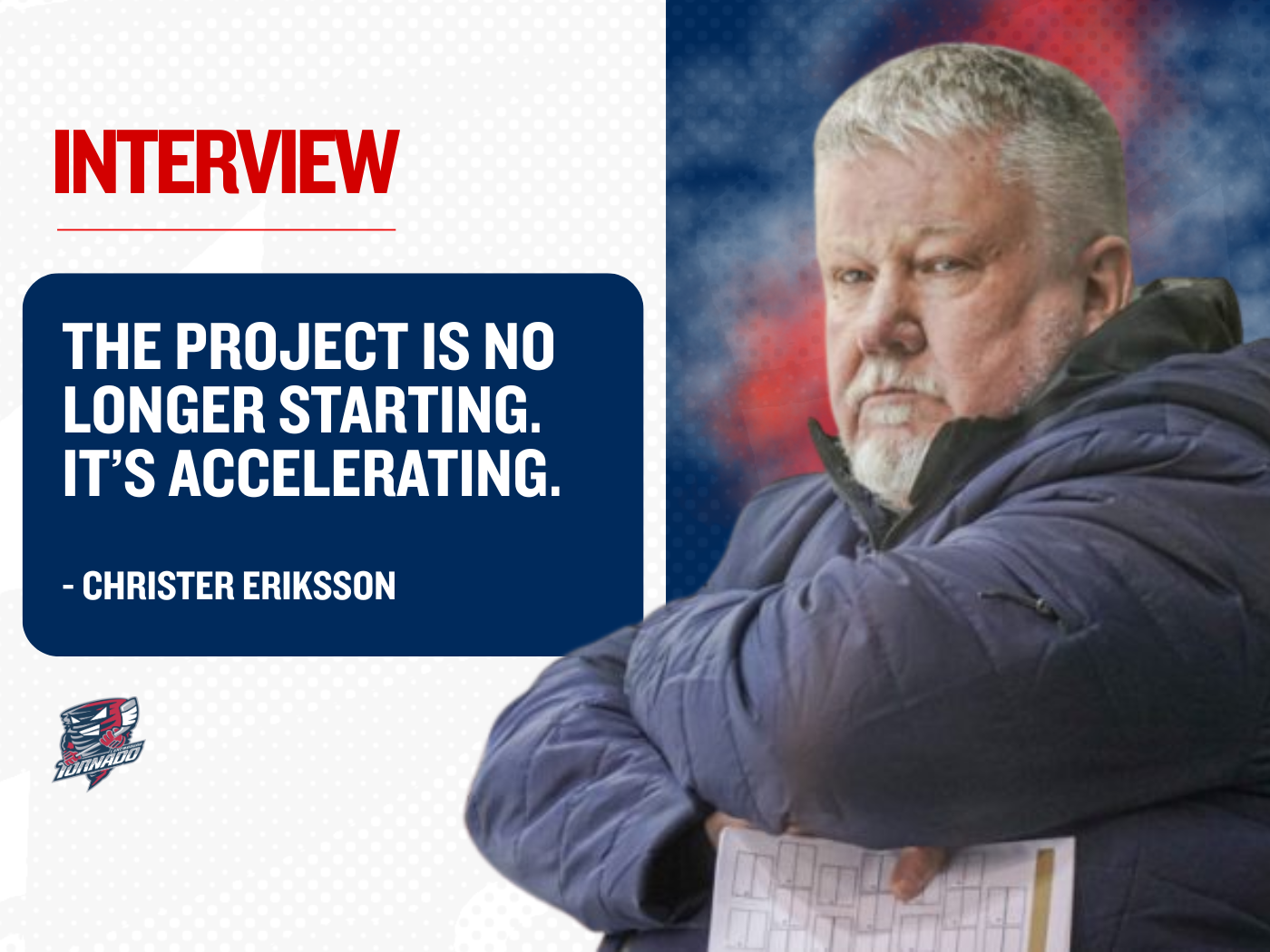
After another milestone season for Tornado Luxembourg, Head Coach Christer Eriksson sat down with us for an extensive conversation reflecting on the club’s evolution, the growing visibility of hockey in Luxembourg, and the ambitions driving the project forward.
Between sporting philosophy, structural challenges, player development, and long-term vision, Eriksson openly shared his thoughts on a season that confirmed Tornado’s rise both on and off the ice.
Christer, now that the season is over, how would you describe the current state of the Tornado project?
I think the biggest word is probably “acceleration.”
A few years ago, we were still building foundations and trying to establish ourselves at this level. Today, the reality is different. The level of play has improved, the organization around the team has become more professional, and the public response has changed completely.
As a coach, what is very encouraging is that you can really feel the club entering another phase. We are no longer simply trying to exist in Division 2. The project is becoming visible, credible, and attractive — both on and off the ice.
And I think it is important to underline that this evolution is only possible because the club leadership has been willing to listen, adapt, and stay open-minded. Patrick Schon, Alain Schneider, and Christophe Thiry have created an environment where ideas can move forward and where the sporting side of the project is truly supported. For a coach, that trust and dialogue are extremely valuable.
This season, Kockelscheuer was regularly close to sold out. How important is that atmosphere for the team?
It changes a lot.
When you arrive at the rink and see more and more people coming every week, when you feel the atmosphere getting louder, when you experience several “full house” nights during the season, it gives energy to everybody. Players feel it immediately.
But beyond the atmosphere itself, it also says something important about the evolution of the project. Tornado is not only becoming a hockey team people follow for results. It is becoming a real sports event, something people want to experience.
That is very important because modern sport is also about creating emotion, identity, and connection with the public.
On the ice, what identity are you trying to build with this team?
We want to build a team that is competitive, but also exciting to watch.
For me, hockey is not only about winning games 1-0 every night. Of course results matter, but the way you play also matters. We want to play offensive hockey, dynamic hockey, a style capable of creating momentum and bringing people into the rink.
When we build the roster, there is a clear logic behind it. You need players who stabilize the structure of the team, players who can create offensively, and leaders who drive the standards every day.
Because in the end, the product on the ice directly impacts everything around the project — the atmosphere, the visibility, the media interest, and even the capacity to attract partners.
Speaking of visibility, did you feel a shift this season around the image of the club?
Definitely.
The media attention is growing, our digital content reaches more people, and there is a broader awareness around the project than before.
I think people now understand that Tornado is not simply a local hockey team. It is becoming a platform with real visibility and ambition. That is important not only for the club itself, but also for the image of hockey in Luxembourg overall.
The positive thing is that the sport is no longer perceived only as a niche activity. More people are discovering it, more young players are entering the system, and there is a clearer connection between development hockey and higher-level competition.
Despite all this growth, you often mention that the club — and Luxembourg hockey in general — is approaching a limit. What do you mean by that?
The project itself is not the problem anymore. The growth is real.
The challenge now is the capacity to support that growth over time.
When you want to develop players properly, improve performance, grow women’s hockey, create stronger youth development, or simply maintain a competitive D2 structure, you need more usable ice time. And that is where the real limitation appears today.
People often look only at the number of hours available, but the real issue is the quality of those hours. Training at impossible times or without enough regularity limits development very quickly.
The talent exists. The motivation exists. The momentum exists. The next step is creating the conditions that allow that momentum to continue.
In your opinion, what are the biggest gaps that still need to be filled for Tornado to continue growing?
There are several, and they are all connected.
First, infrastructure remains a major topic. Ice availability is obviously one part of the equation, but there are also many practical elements around a semi-professional environment that people do not always see immediately — dedicated locker rooms, recovery areas, better working spaces for players and staff, and generally more professional day-to-day conditions. Those things matter when you want to stabilize and grow a high-level structure.
Then there is the human organization around the team. The club has already grown enormously in recent years, but to continue progressing, the organizational structure also needs to expand. More people, more specialized roles, and more operational capacity are necessary if you want to sustain this level of ambition over time.
And finally, like every ambitious sports project, resources remain fundamental. If you want to operate closer to semi-professional standards, you need stronger revenue-generation capacity, stronger commercial structures, and the ability to continue developing partnerships and visibility around the club.
The positive aspect is that these are growth problems. They exist because the project is moving forward.
Looking ahead, what can fans expect from the 2026/27 Tornado roster?
The objective will be continuity — but also evolution.
We want to keep a strong core identity within the team while continuing to raise the overall level and competitiveness of the roster. The idea is not to change everything every season, but to progressively build something more stable, more mature, and more complete year after year.
Next season, there will probably be a little more internal competition within the roster and more depth overall. That is important over a long season. At the same time, several of our younger players are reaching an age where they should naturally take another step forward in terms of maturity, confidence, and physical presence. That progression inside the club is something very positive for the future.
Our ambition is clear: we want to continue progressing every season and establish Tornado as a team regularly competing for the semifinals within the next three years. That requires patience, continuity, and smart development — but the direction is there.
This offseason is already very active. Together with Team Manager Loïc Darras, we are working closely on the construction of the 2026/27 roster. I think we have developed a very efficient partnership in this phase, trying to identify the right profiles not only in terms of talent, but also mentality and fit with the project.
And yes… supporters will not have to wait too long before hearing some names. We will have announcements coming very soon.
Finally, what feeling do you take away from this 2025/26 season?
Pride, honestly.
Not only because of the sporting results, but because of the direction the club is moving toward. You can feel that something is being built here — progressively, but very genuinely.
This season confirmed that the potential is real. The public is growing, the credibility is growing, the visibility is growing, and the ambition is growing too.
And none of that happens without the people around the club. The supporters, the volunteers, the staff, the partners — everybody contributes to this evolution.
The important thing now is to keep building together, because this project is still far from reaching its ceiling.