
Buidling on What We've Started
29th July 2026
Tornado Luxembourg
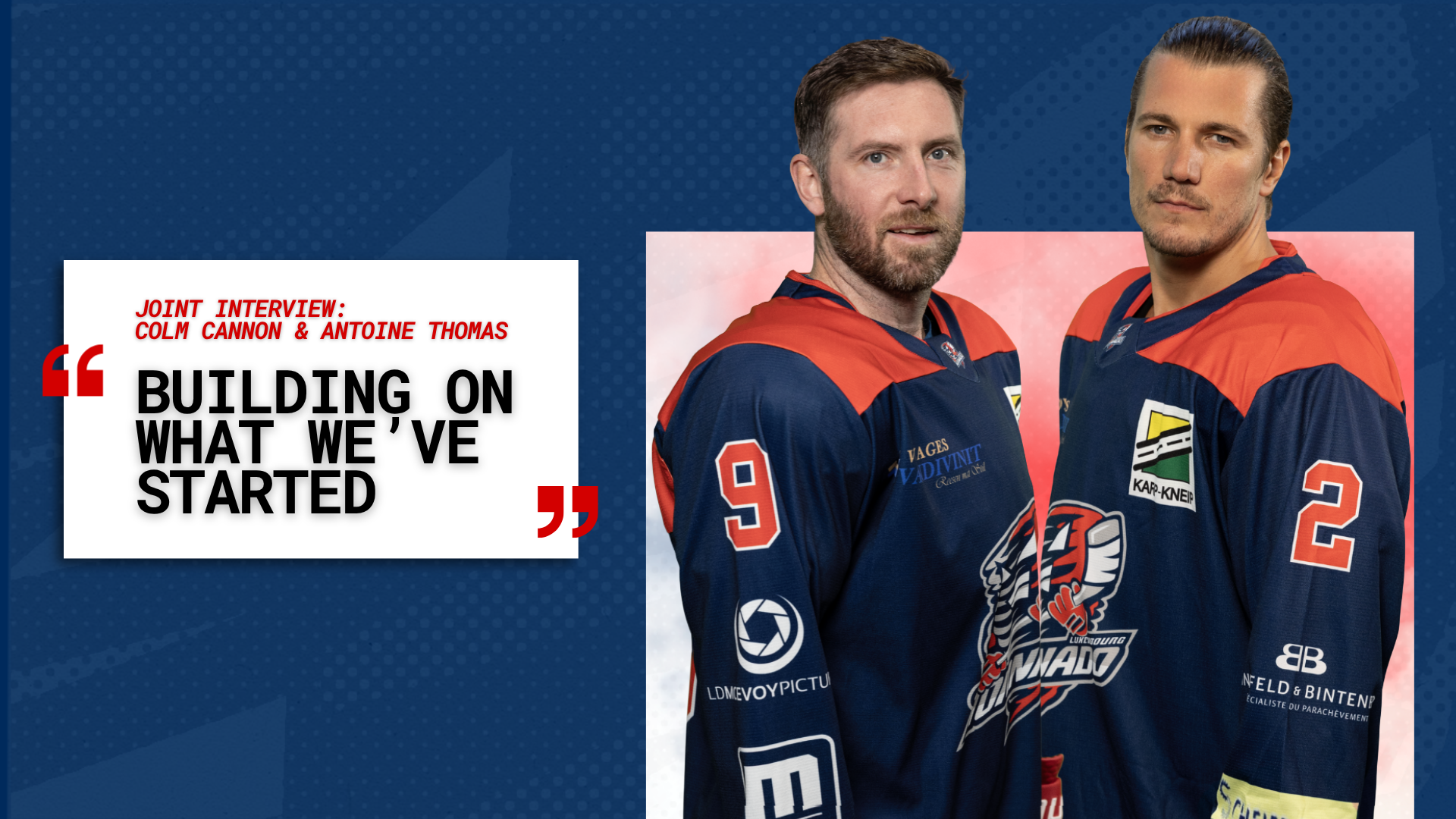
As Tornado Luxembourg prepares for the 2026/27 season, Captain Colm Cannon and Assistant Captain Antoine Thomas discuss the evolution of the team, the importance of continuity and the next steps in the club’s development.
They also share their view on the wider progress of Luxembourg hockey, from youth development and the Foxes pathway to National Teams, governance and infrastructure.
Before looking ahead to 2026/27, how do you assess where Tornado stands today and the progress made over the last few seasons?
C.C.: A lot has happened in a relatively short period of time. We earned promotion to Division 2 and then had to discover what it really takes to compete consistently at that level. It has been a learning process. The level is higher, teams are deeper and the margins between winning and losing can be very small. Every season teaches you something about where you are and what you still need to improve. But the evolution is not only visible on the ice. More people are coming to our games, there is greater visibility around the team and you can feel more interest developing around Tornado. At the same time, we have to remain very humble about where we are. We are still at the beginning of something. We have started building, but there is still a long way to go. We are building a new club culture, and that takes time.
A.T.: I think that is important. We should be ambitious about where we want to go without pretending that everything is already in place. The club has progressed quickly, but sustainable progress takes time. For me, the most encouraging thing is that we can now build on experiences from previous seasons. As players, we understand our environment better, we understand the level better and we know more about what it takes to compete consistently in this league. Our staff also has a much clearer picture now of the group, the level and what is required to keep moving forward. The objective is simply to keep progressing every day.
Looking at the group taking shape for 2026/27, how do you see the evolution of the roster?
A.T.: What is interesting is that we are not looking at a completely new team. There is a core group that remains together, and around that you see different profiles coming in who can bring additional qualities and depth to the roster. That is important because you want the team to evolve without losing everything that has been built before. The staff knows the group very well and has a clear idea of the qualities that can complement what is already there. When you play a full season together, you naturally become aware of your strengths but also of situations where the team could have more options. Looking at the group taking shape, I think there is a feeling that we can have more solutions and greater depth. Now it is up to us as players to make all those pieces work together.
C.C.: That is the key. A name or a CV does not automatically make a team better. The important part starts when everyone gets into the locker room and onto the ice together. The staff can bring in different profiles and create the sporting framework, but then the players have to build trust and chemistry. For those of us who have been here, our responsibility is to help the new and younger players settle in quickly and understand the group they are joining. It is also worth saying that these changes are not only driven by a simple desire to do things differently. Over the last few seasons, this roster has gone through a real generational shift, and competing at this level now asks a lot more of players and volunteers who remain 100% amateurs. One of the things we are genuinely proud of is that, through that shift, almost all our former players have stayed within the Luxembourg hockey family in one role or another. That continuity says a lot about what we are building here, beyond any single season or roster.
From inside the locker room, how important is the balance between different profiles within a team?
A.T.: It is extremely important. A good team needs different qualities. You need experience and youth. You need players who can create offensively and others who are comfortable doing work that may be less visible. You need different personalities and different ways of contributing. You also need depth because a season is long. There will be injuries, absences, suspensions and changes in form. Having different options within the group also creates healthy competition. It gives the staff more possibilities and forces everyone to maintain high standards.
C.C.: Everyone also needs to understand that being important to the team does not always mean having the same or most “visible” role. Some contributions are very visible. Others are not. The strongest locker rooms I have been part of are the ones where players understand that difference and still put the collective first. The staff sets the roles and the expectations, but as players we must accept them and make sure the team always comes before individual interests.
A significant part of the core group remains together. How important is continuity?
C.C.: Massive. Teams don't become close because they simply spend months together. They become close because every generation passes something on to the next. That's probably the biggest responsibility of a captain. When you have been through seasons together, travelled together, won games together and gone through difficult moments together, you develop relationships that are difficult to reproduce immediately. You understand how people react. You know who will speak in certain situations, who brings energy, who needs support and how the group responds when things are not going well. That becomes part of the identity of a locker room. If a team changes completely every summer, you must recreate all of that every September. The fact that we can keep building from an existing core is very valuable.
A.T.: Continuity also helps on the ice. You already have relationships and automatisms. You understand how certain teammates play and react, and the coach does not have to restart everything from zero. Of course, new players bring new energy, new experiences and different ideas, which is important as well. The challenge is to combine those two things: preserve what works while being open to what new players can bring.
Colm, as Captain, what makes a player truly fit into the Tornado locker room beyond simply being a good hockey player?
C.C.: Character is extremely important. Obviously, quality on the ice matters. But during a season you spend an enormous amount of time together. You train together, travel together and experience good and bad moments together. That is when you discover what kind of teammate someone really is. We value players who work for the team, who are humble and who respect the group. There will always be moments when things are not exactly how you want them personally. Maybe you are not playing as much as you would like. Maybe your role changes. Maybe the coach asks you to do something different for the team. How you react in those moments matters. The principle is simple: nobody is bigger than the team.
Antoine, as Assistant Captain, what role does the leadership group play when new players join an established locker room?
A.T.: Our responsibility is mainly to help them integrate. Sometimes it is as simple as making sure a new player never eats lunch alone during his first week. When you arrive in a new country and a new team, there are a lot of things to understand very quickly, both on and off the ice. Inside the locker room, there are also standards and habits that are not necessarily written anywhere. They come from everyday behaviour: how we train, how we prepare, how we react after a difficult game and how we treat each other. The staff sets the overall standards and direction, but the leadership group has an important role in making sure those standards live every day inside the locker room. At the same time, integration works both ways. New players come with different experiences, sometimes from different hockey cultures, and we also must listen to them and allow them to bring something new to the group. The best situation is when a new player quickly feels that he belongs while also adding something of his own.
Beyond wearing the "C", what do you see as the biggest responsibility of the leadership group within Tornado?
C.C.: People often think a captain's role is about speaking before games or talking to referees. In reality, it is much broader than that. Our biggest responsibility is to protect and pass on the culture of the team. Our job isn't to build the club. Our job is to protect what makes this team special. There are many things that are never written down anywhere: how we prepare every day, how we train, how we react after a defeat, how we welcome new players, how we treat the staff, our volunteers and our teammates. That culture is built over years, and if nobody transmits it, it disappears very quickly. Every new player arrives with his own habits and experiences, which is a positive thing, but it is also our responsibility to help them understand what it means to be part of Tornado.
A.T.: Exactly. Christer and the staff establish the sporting direction, the standards and the identity they want on the ice. As captains, our role is to make sure those values are lived every single day inside the locker room. Culture is not something you create through speeches; it comes from hundreds of small actions that are repeated every day. The best compliment for us is when, after a couple of weeks, you honestly can't remember who arrived this summer and who has been here for three years. If a new player quickly understands those unwritten rules, then he will usually integrate much faster. Ultimately, that is probably one of the most important jobs of a leadership group: making sure that every season starts where the previous one finished, rather than having to rebuild the culture from scratch.
Tornado appears to be attracting increasing interest from players who want to join the project. As players already inside the club, how do you perceive that?
C.C.: It is encouraging because it means people outside the club are noticing what is happening here. As players, we see the evolution every day, but when people from outside start asking about Tornado or showing interest in joining, it gives you another indication that the project is becoming more visible. There are many reasons for that. We play in a competitive French championship, the atmosphere around our home games has developed significantly and Luxembourg offers a very particular environment. The work being done by the staff, the club management and everyone around the team also gives the project more credibility. But the important thing is to stay grounded. Interest is positive, but we still have a lot to build.
A.T.: In my opinion, what matters most is what happens once someone arrives. Whatever their background or experience, once they enter the locker room, everyone becomes part of the same group. When you arrive in August, everything is new: a new country for some, new teammates, sometimes even a new language. If after two weeks you still feel like 'the new guy', we've probably failed somewhere. The coach and management decide which profiles can help the team. Our role is different: once the players are here, we must make sure we become a team as quickly as possible.
Does the fact that players increasingly want to join Tornado change the dynamic inside the existing group?
A.T.: It can create positive energy. When you see players interested in joining the club, it reminds you that being part of this team is something valuable. It can also create healthy competition. Nobody should take his place for granted, and that naturally raises standards in training and games. At the same time, the staff must manage that competition properly and make sure everyone understands his role. For us as players, the important thing is that competition remains positive and always serves the collective.
C.C.: It also creates responsibility for the players who are already here. We represent Tornado every day. The culture of a club is not only created by coaches or management. It is also created by how players behave. If we want good players and good people to be part of this environment, then we have a responsibility to make the environment a good one.
Looking at the 2026/27 group, do you feel Tornado will have more depth and more options?
A.T.: That is certainly the impression when you look at the different profiles in the group. There seems to be more depth and different types of players who can potentially provide different solutions. That should also give the team more possibilities depending on the opponent, the situation in a game or the form of certain players. But we also need to be careful about making conclusions before we have played together. A roster can look strong on paper, but hockey is not played on paper. The real question is how quickly we can become a team.
C.C.: Exactly. Every season starts with a group of individuals. Then you have to build trust, chemistry and habits. The staff creates the structure and the direction, but the group has to bring it to life. That is where the returning core can hopefully help. There is already something in place. The objective is not to protect that from change, but to use it as a starting point for the next step.
Colm, you are also a member of the Huskies management committee. Looking at Luxembourg youth hockey today, do you feel we are beginning to see the foundations of the Tornado for tomorrow?
C.C.: Definitely, and for me this is one of the most encouraging things happening in Luxembourg hockey. The number of young players has increased significantly, but what is especially important is that we are also seeing progress in quality. Young players are getting more hockey, more structured development and exposure to competitive environments, and there has been excellent investment and structuring of the youth programme over the last few seasons. The Huskies continue to develop through the French youth leagues, and there are positive developments elsewhere in Luxembourg hockey as well. But we need to understand the timescale. A young player starting today will not be ready for senior performance hockey tomorrow. Development takes years. That is why what we are doing now is so important. For me, one of the ways we should eventually measure Tornado’s progress over time is by looking at how many Luxembourg-developed players can genuinely compete for places in the team. Players coming from different hockey backgrounds will continue to bring quality and valuable experience, but over time we also need to develop more players ourselves. That is essential if we want the whole ecosystem to become sustainable.
One of the historical challenges has been the gap between youth hockey and senior performance hockey. How important are the Foxes in creating that missing bridge?
C.C.: They are absolutely essential. That transition is extremely difficult. You can be a very good youth player and still not be ready to immediately play an important role in senior hockey. The game becomes faster, stronger and more demanding physically and tactically. You need somewhere to learn that. That is what the Foxes can provide. Young players can experience senior hockey, get meaningful ice time, take responsibility and make mistakes. Making mistakes is part of development. If a young player only gets a few shifts in an environment where he is afraid of making an error, development becomes very difficult. The Foxes can provide that intermediate step. I also think their role can go beyond being simply a pathway towards Tornado. They can become a real development laboratory for Luxembourg hockey. You can give young players responsibilities, expose them to senior situations and progressively prepare them for higher levels and potentially the National Teams. If we manage that pathway properly, it can become extremely valuable.
You are both Luxembourg National Team players. From that perspective, do you feel the different pieces of Luxembourg hockey are beginning to connect more clearly?
A.T.: Yes, I think a clearer pathway is progressively emerging. For a small hockey country, that is essential. We cannot have youth hockey, development programmes, senior clubs and National Teams all operating independently. A young player should be able to look ahead and understand what the next steps could be: youth hockey, development programmes, the Foxes, senior environments such as Tornado or Beaufort, and ultimately the National Teams. Not every player will follow the same path, of course. But the pathway needs to exist and become increasingly clear.
C.C.: As a National Team player, you understand very quickly why this matters. At international level, weaknesses are exposed immediately. If we want Luxembourg to become sustainably more competitive, we cannot simply wait for one particularly talented generation to appear. We need to progressively create an environment that produces better-prepared players more consistently. That process begins many years before someone plays for the National Team.
Luxembourg hockey itself is entering a new phase of structuration under DTN Christer Eriksson. As National Team players, how do you view that evolution?
C.C.: I think it is important to remember where this actually started. A few years ago, the FLHG went through a genuine reflection about where Luxembourg hockey needed to go, and that led to bringing in people like Christer, to the FLHG, and others who now lead the development. That was really the trigger for everything that has followed. Progress since then has not always been fast — these things take time — but it has been real. We now have a DTN, a National Coach and a clearer technical structure, as well as administrative and secretarial roles that simply did not exist a few years ago. It is a natural evolution, in a way. Hockey in Luxembourg has grown significantly. There are more players, more young players, more teams, more projects and greater ambitions. When that happens, the structure around the sport also has to evolve. Volunteers and passionate people have built an enormous amount, and they will always remain essential. But as the sport grows, you also need more continuity, clearer responsibilities and stronger technical coordination. This new FLHG staff has a very clear vision of where Luxembourg hockey needs to go, and having that long-term direction is important if we want the different parts of the system to progress together.
A.T.: I believe what matters is having a clearer environment and more continuity. Ultimately, clubs and National Teams benefit from each other. If youth development improves, senior clubs eventually receive better-prepared players. If clubs provide stronger competitive environments, National Team players improve. If the National Teams become more competitive, Luxembourg hockey gains visibility and credibility. Everything is connected. The important thing is that the federation, the technical direction, clubs and players increasingly move in the same direction. We are in good hands on this.
Coming back to Tornado, what identity do you want this 2026/27 team to have on the ice?
C.C.: We want to be a team that is difficult to play against. I do not mean only physically. It means competing for every puck, playing with intensity, being disciplined and staying together when games become difficult. Consistency is probably one of the biggest steps any team has to make if it wants to progress. It is relatively easy to play one great game. The challenge is bringing those standards every week. The staff sets the framework and the way it wants us to play, but as players we must bring that identity to life every night.
A.T.: We also want to be able to respond to different situations. Every opponent is different and every game develops differently. Having different profiles within the group should give the coaching staff more options. But whatever happens tactically, the collective identity must remain. We have to play as a team. That sounds obvious, but it is probably one of the hardest things to achieve consistently.
How ambitious can Tornado realistically be in 2026/27?
C.C.: We have to be ambitious. But ambition is not something you prove by making a prediction before the season starts. You prove it through the standards you set every day. We want to improve. We want to become more consistent. We want to compete with the strongest teams and put ourselves in a position where important games really matter. The club will set the objectives and expectations for the group, but from a player’s perspective, our responsibility is to make sure our daily standards match our ambitions. Where that takes us, we will see. We are still building, and we must remain humble about that. But being humble does not mean limiting your ambition.
A.T.: Exactly. For me, the objective is to keep closing the gap. Every day should teach us something. What prevented us from taking another step? What can we improve? What do we need to do better, as players or as a team? If we keep answering those questions and making progress, our ambitions can grow naturally with the project. Ambition should be the consequence of progression, not just something you announce before the first game.
Finally, if we were having this same conversation five years from now, what would need to have happened for you to say that the Tornado project had truly succeeded?
C.C.: I would love to walk into the Tornado locker room and see several players who started in Luxembourg youth hockey, developed through structures like the Huskies, earned their place with Tornado and became important National Team players. It will take years, but we’ll get there. That will mean we have created a real pathway. Not just one good generation, but something sustainable. If a young kid starting hockey in Luxembourg today can come to a Tornado game, look at the players on the ice and genuinely think, “That could be me one day,” then we will have achieved something important.
A.T.: I would like Tornado to have become a club that is sustainably established at a strong competitive level. A club that players want to be part of, that supporters identify with and that has a positive place within Luxembourg hockey. But sustainability is the key word. Success cannot mean having one exceptional season and then starting again from zero. We are focused on 2026/27 because that is the next step in front of us. But the project is bigger than one season. We are not pretending that everything has already been built. We have started something. Now, as players, our responsibility is to give everything we can to help the team, staff and the club keep moving forward.